


Ask ten people where they want to be in five years, and most will shrug. That shrug costs more than you think. Without clear career goals, you drift from job to job, say yes to whatever shows up, and one day wonder where the last three years went.
The good news is that setting career goals is a skill you can learn, not a talent you are born with. In this guide, you will learn how to figure out what you want, turn it into a plan, and keep going when work gets busy. By the end, you will have a simple roadmap you can start using today.

Why Career Goals Matter More Than a Job Title
A job title tells people what you do. Your goals tell you where you are heading. That difference matters, because direction makes every decision easier.
Should you accept an offer with higher pay but no room to grow? Should you spend your evenings on a course or rest? When you know your destination, you have a filter for these choices.
Clear goals also help in very practical ways:
- A sharper job search: You apply to roles that fit your career path instead of every opening you see.
- Better interviews: When someone asks, “Where do you see yourself in five years?”, you have a real answer.
- A stronger resume: You know which skills and achievements to put first.
- Steady motivation: Progress becomes visible, so it is easier to stay consistent.
Short-Term vs Long-Term Career Goals

Goals work best when you separate them by time. Think of the long-term goal as your destination and the shorter ones as the turns on the map.
Short-Term Career Goals (0 to 12 Months)
These are steps you can finish soon: earning a certification, rewriting your resume, learning a new tool, or getting an interview at a company you admire. They build momentum and quick confidence.
Mid-Term Goals (1 to 3 Years)
This is where promotions, industry switches, and bigger responsibilities live. Examples include leading a project, moving into a remote role, or becoming the go-to person for a specific skill.
Long-Term Career Goals (3 to 10 Years)
These describe the bigger picture of your professional life: managing a team, becoming a specialist, working independently as a consultant, or reaching a senior position. They can change over time, and that is completely normal.
How to Set Career Goals in 6 Simple Steps
1. Start With Honest Self-Reflection
Write down what you enjoy, what you do well, and what drains you. Look at your last two jobs. Which tasks made time disappear? Which ones did you avoid? Your answers point toward the work that suits you and the professional development that will pay off most.
2. Pick a Direction
You do not need a perfect ten-year plan. A rough direction is enough, such as “I want to work in marketing and eventually lead a small team.” You can sharpen it as you learn more about the field and about yourself.
3. Make Each Goal SMART

SMART goals are Specific, Measurable, Achievable, Relevant, and Time-bound. Compare these two:
- Vague: “Get better at my job.”
- SMART: “Finish a project management course by June and lead one small project by September.”
The second version tells you exactly what to do and when you have succeeded.
4. Break Goals Into Milestones
Big goals feel heavy because they hide the small steps inside them. If you want a promotion in 18 months, your milestones might be: ask your manager what the next level requires, close one skill gap, and take on one visible project. Each milestone is small enough to start this month.
5. Research the Skill Gap
Look at what employers actually ask for. Browse job listings for the role you want and note the skills that appear again and again. Compare that list with your own. The difference is your upskilling plan, and it tells you what to learn first.
6. Schedule a Review
Put a reminder in your calendar for every three months. Ask yourself what worked, what changed, and what needs adjusting. A goal you never review quietly turns into a wish.
Examples of Career Goals You Can Borrow

Not sure how to word your own? Use these as templates and change the numbers and dates to suit your life.
For fresh graduates: “Land my first role in data analysis within four months by applying to ten jobs each week and having my resume reviewed twice.”
For employees seeking growth: “Earn a promotion within 18 months by completing a leadership course and managing one cross-team project.”
For career changers: “Move from teaching into HR within a year by finishing two certifications and building three portfolio samples.” If you are planning a switch like this, our career change guide walks you through the full process.
For remote workers: “Secure a fully remote position within six months by improving my communication tools and documenting my remote results.” Our remote work guide covers what employers look for.
Notice what these examples have in common: each has a clear outcome, a deadline, and an action you control. That is what turns a long-term vision into a plan you can follow.
Turn Your Goals Into Daily Action

Writing goals takes ten minutes. Following through takes habits. Try these:
- Plan weekly: Spend 20 minutes every Monday choosing the two or three actions that move you forward this week.
- Build the right tools: If your goal is a new role, your resume must reflect it. Our resume builder helps you create a clean, ATS-friendly version in minutes.
- Practice before it counts: Rehearse your answers out loud so you do not freeze when it matters. Our interview guides include common questions and sample answers.
- Find accountability: Share your plan with a mentor, colleague, or friend who will ask how it is going.
- Celebrate small wins: Finished a course? Got a reply from a recruiter? Write it down. Progress you can see keeps you moving.
Tracking your progress also gives you great material for future interviews and performance reviews, because you can point to specific results instead of general claims.
Common Mistakes When Setting Career Goals
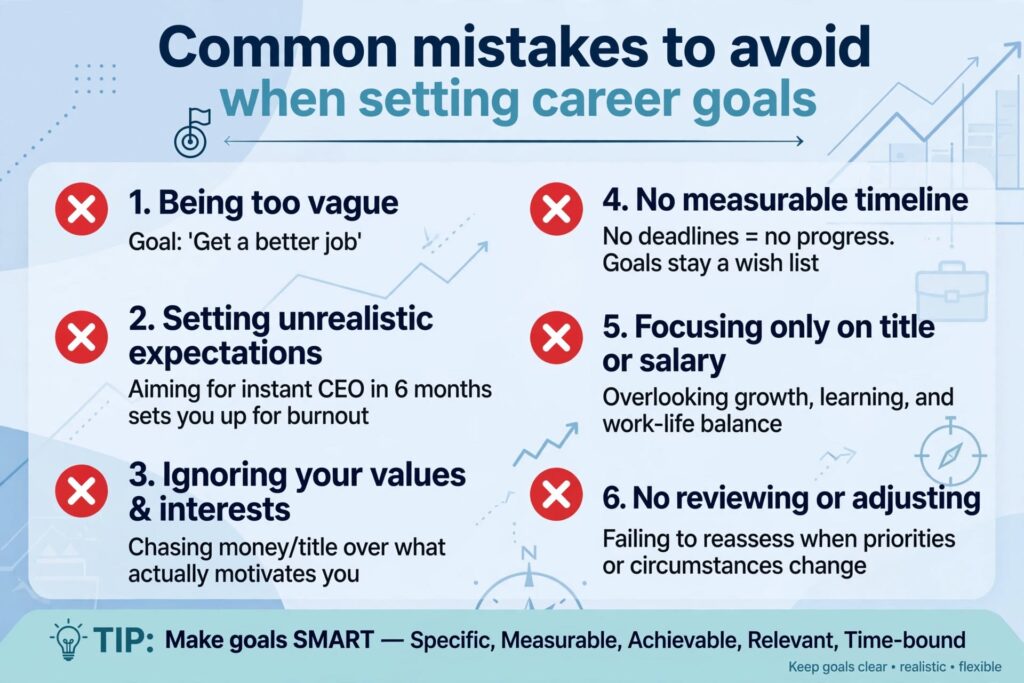
Even motivated people trip over the same problems. Watch out for these:
- Being too vague: “Be successful” cannot be measured or planned.
- Setting too many at once: Three to five focused goals beat fifteen scattered ones.
- Copying someone else’s path: A goal that excites your friend may bore you. Choose what fits your values, strengths, and lifestyle.
- Ignoring skills: A big goal without skill development is just a hope.
- Never reviewing: Your situation changes, so your plan should change with it.
- Waiting for the perfect plan: Start with a rough version and improve it as you go.
Frequently Asked Questions
How many goals should I have at one time?
Aim for three to five. That is enough to cover short-term and long-term priorities without spreading your energy too thin.
What are good goals for a fresh graduate?
Start with practical ones: build a strong resume, apply consistently, practice interviews, and gain one in-demand skill. Once you land a role, shift toward learning and career growth.
How often should I review my plan?
Check in every three months and do a deeper review once a year. Update it whenever you change jobs, learn something new, or realise your priorities have shifted.
What if my goals change?
That is normal and healthy. Changing direction does not mean you failed. It means you learned something about what you want. Keep the skills you have built and adjust the plan.
Conclusion
Strong career goals give your work a direction, your decisions a filter, and your effort a purpose. Start small: reflect on what you want, write one SMART goal, break it into milestones, and review it every three months. Progress comes from steady action, not perfect plans.
Ready for your first step? Pick one goal today, write it down with a date, and take the first action this week. Your future self will thank you.
