- The Technology of Automated Vocal Synthesis
- Will Disney use AI voice cloning to replace Tom Hanks in Toy Story 6?
- Hollywood’s Evolving Data Integration Frameworks
- Landmark Cinematic Milestones in Data-Driven Performances
- The Legal Battles Over Digital Likeness
- The Threat of Audience Indifference to AI
- 🚨 What Do You Think? Join the Debate Below!
Toy Story 6 AI Voice Cloning: Tom Hanks Warns of Disney Tech
The cinematic landscape is currently adjusting to a historic theatrical milestone. Following its official global release on June 19, 2026, Pixar’s Toy Story 5 directed by animation veteran Andrew Stanton completely shattered box office records worldwide. The film brought in a massive, franchise-best $159.6 million during its domestic opening weekend and generated an incredible $312 million global launch.
Yet, underneath the immense financial success of the newly released film lies a growing industry debate regarding long-term talent sustainability, artificial intelligence, and digital intellectual property ownership.
The face of this discussion is two-time Academy Award winner Tom Hanks. In recent promotional circuits for the film, Hanks openly questioned the future of his iconic role as Sheriff Woody, detailing how major studios now possess the raw tools required to construct a completely automated, posthumous, or actorless performance for potential subsequent entries like Toy Story 6.
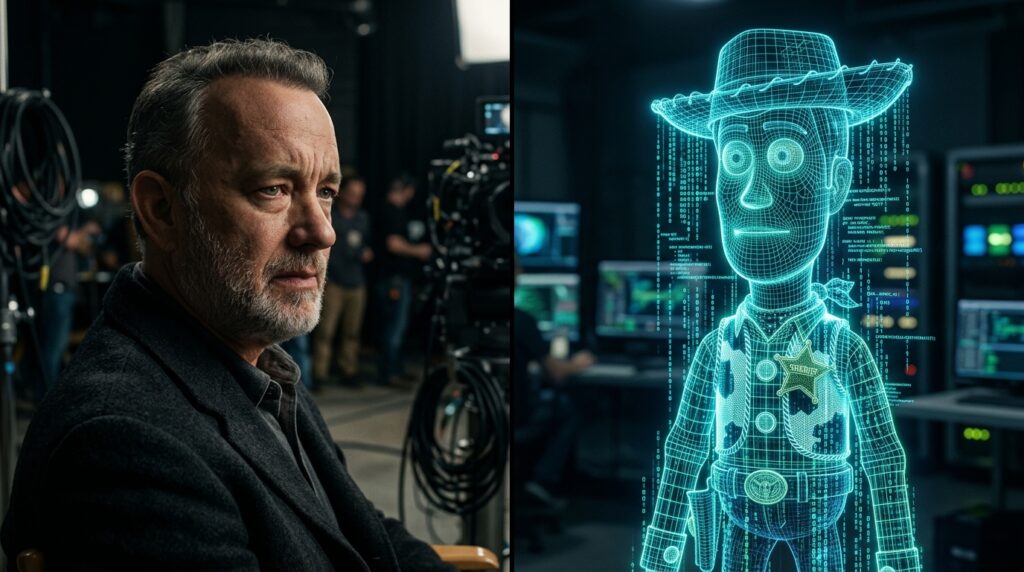
The Technology of Automated Vocal Synthesis
Will Disney use AI voice cloning to replace Tom Hanks in Toy Story 6?
The definitive answer: While Disney has not officially greenlit Toy Story 6 or confirmed synthetic voice strategies, Tom Hanks has verified that the studio possesses over thirty years of his recorded digital dialogue data, making an AI voice replication technically viable. Both Hanks and his longtime co-star Tim Allen (the voice of Buzz Lightyear) have publicly characterized the potential for automated, actorless franchise continuations as “a scary thought,” emphasizing that any future installment must rely on thematic merit rather than algorithmic necessity.
The concept of replacing a living or returning actor through post-production machine learning models is no longer localized to the realm of science fiction. During an explicit industry debrief, Hanks highlighted that every single vocal tone, character inflection, and individual word captured during his three-decade stint voicing the character exists in a high-fidelity digital media archive somewhere.
Historically, generating vocal lines without an actor required meticulous audio splicing, manual editing, or finding a vocal match double. In 2026, advanced artificial intelligence algorithms can easily parse these massive historical audio repositories to build interactive vocal models.
These systems allow software engines to convert plain-text scripts directly into a lifelike vocal performance. The algorithm accurately mimics the performer’s specific pitch, accent pacing, and emotional dynamic range meaning a studio could hypothetically “put together anything they would want” without ever booking recording booth time.
Hollywood’s Evolving Data Integration Frameworks
The friction surrounding synthetic voice replication highlights a massive generational change in how studios negotiate actor likeness rights and capture raw performance data.
Landmark Cinematic Milestones in Data-Driven Performances
| Film Title & Release Year | Primary Production Technology Deployed | Creative Purpose & Objective | Long-term Industry Precedent |
|---|---|---|---|
| The Polar Express (2004) | Motion-Capture & Volumetric Data Storage | Digitally map physical human performances onto animated characters. | Established the early studio infrastructure for compiling extensive actor data libraries. |
| Here (2024) | AI-Driven Real-Time Generative De-Aging Tools | Instantly alter the physical appearance of performers during filming. | Reduced traditional post-production windows down to instantaneous processing times. |
| Toy Story 5 (2026) | Traditional Spatial Audio Capture & Digital Archiving | Deliver standard human character portrayals while updating thematic elements for a tech-heavy narrative. | Solidified over 30 years of vocal records, rendering future synthetic cloning viable. |
The Legal Battles Over Digital Likeness
The legal reality confronting Hollywood in 2026 is complex. When Hanks signed his original contracts for the initial Toy Story film in the mid-1990s, commercial artificial intelligence and high-fidelity deepfake voice technology did not exist. Legacy legal clauses giving a studio the right to use an actor’s “recorded voice” were built with re-releases, trailers, and standard marketing in mind not for generating entirely new performances from archived individual syllables.
While recent regulatory updates, such as California’s AB 2602 bill and the landmark SAG-AFTRA strike agreements, require explicit, clear consent before a digital replica can be utilized in place of a human performer, loopholes remain an issue. Independent voice actors who sign restrictive work-for-hire agreements often lack the legal leverage of an A-lister like Hanks.
Furthermore, if an actor passes away, the ultimate rights over their vocal legacy fall onto their estate or living will instructions, paving the way for potential multi-generational corporate control over famous cinematic characters.
The Threat of Audience Indifference to AI
While legal departments grapple with image permissions, copyright boundaries, and performance rights, Hanks has pointed out a much more fundamental threat facing traditional media: the risk of shifting consumer expectations.
The primary concern is not just the speed at which the software evolves, but whether modern cinemagoers will simply lose interest in verifying if what they are viewing is an authentic human creation. If consumers accept completely synthetic content without pushback, the unspoken social contract that binds creators to their viewers could be permanently broken.
“Here’s what I worry about: that there will be something that will be blatantly AI created, imagined, produced, the whole bit and the audience won’t care that it’s AI.” Tom Hanks on the future of theatrical distribution.
For an entertainment ecosystem like Screen Juice, tracking these technological movements is vital. The ongoing friction between iconic legacy talent and the relentless forward march of automated studio tech will shape the future of mainstream distribution. It will ultimately determine whether the industry chooses human creativity or algorithmic optimization.
🚨 What Do You Think? Join the Debate Below!
- Would you watch an entirely AI-voiced Toy Story 6 if Tom Hanks chooses not to return, or would you boycott the movie?
- Should Disney hire a human voice-match double (like Tom’s brother, Jim Hanks) instead of relying on digital algorithms?
- Do you think audiences will eventually stop caring if an animated performance is real or completely synthetic?
Sources