



- Why Career Changers Get Stuck
- How to Change Careers With No Experience in 7 Steps
- Transferable Skills Examples You Can Use
- How to Write a Career Change Resume Summary
- Beginner-Friendly Roles to Consider
- How to Answer “Why Are You Changing Careers?”
- Mistakes to Avoid When Learning How to Change Careers With No Experience
- Frequently Asked Questions
- Conclusion
You want out of your current field, but every job post asks for experience you do not have. Here is the good news: learning how to change careers with no experience is less about starting from zero and more about proving what you already bring to the table.
In this guide, you will find your transferable skills, close small gaps quickly, and present yourself so employers see potential instead of a blank page.
Why Career Changers Get Stuck
Most people hear “no experience” and assume “no value.” That is the first mistake. Employers hire people to solve problems, and you have been solving problems for years, just under a different job title.
When a hiring manager looks at a career changer, they usually wonder about three things:
- Can this person learn quickly?
- Will they stay long enough to be worth training?
- Can they handle the core tasks of the role?

Your job is to answer all three before the interview even starts. The steps below show you how to change careers with no experience without guessing.
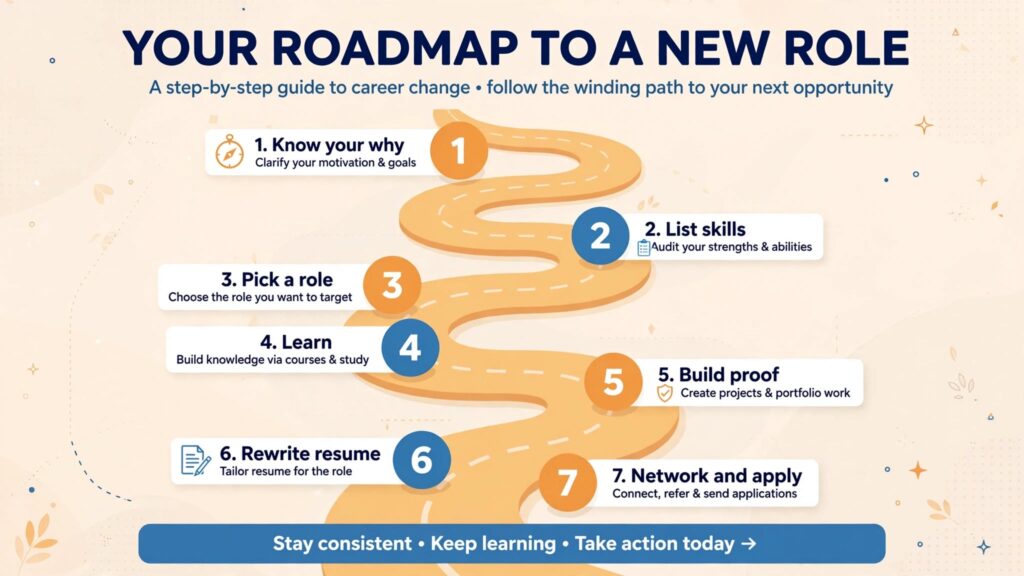
How to Change Careers With No Experience in 7 Steps
1. Get Clear on Why You Want to Switch
Be honest about what is pushing you out. Is it the pay, the stress, the lack of growth, or the work itself? If you only want to escape a bad boss, a new employer in the same field might solve it. If the work itself no longer fits, a real switch makes sense.
2. List Your Transferable Skills
Transferable skills are abilities that work in many jobs, such as communication, organisation, problem-solving, leadership, and customer handling. Write down every task you did in your last two roles, then ask: “What skill did this prove?”
For example, handling an angry customer at a store proves conflict resolution. Scheduling a team proves planning. Training a new colleague proves coaching.
3. Pick a Realistic Target Role
Aim for an adjacent role, one step away from what you already do, rather than a jump to something completely unrelated. A shop supervisor can move into customer success far more easily than into software engineering. Spend an hour browsing job listings for entry-level and junior roles, and note which requirements appear again and again.
4. Close the Skill Gap With Short Learning
You do not need a second degree. Pick the two or three most repeated skills from those listings and learn them in four to eight weeks through online courses, free tutorials, or beginner certificates. Focus on tools you will actually use, such as spreadsheets, a CRM, or project management software.
5. Build Proof Before You Have a Job Title
This is the part of how to change careers with no experience that most guides skip. Since you cannot show paid experience, show evidence instead:
- Complete a small project related to your target role.
- Volunteer for a nonprofit that needs help in that area.
- Take on one low-cost freelance task for a friend or local business.
- Create a simple portfolio page or a document with two or three samples.
Even one finished project tells an employer you can do the work.
6. Rewrite Your Resume for the New Direction
Your old resume tells your old story. Move your skills and relevant projects to the top, and keep your job history short and focused on results that match the new role. Our resume builder can help you create a clean, ATS-friendly version in minutes.
7. Network and Apply Strategically
Applications alone rarely work when you are switching fields. Message people who already hold the role, ask for a 15-minute chat, and ask what they wish they had known. Then apply to roles that match your new resume, and tailor each one. Ten careful applications beat fifty copy-and-paste ones.
Transferable Skills Examples You Can Use

Not sure how your background fits? Here are common switches and the skills that carry over:
| Current Job | Possible New Role | Skills That Transfer |
|---|---|---|
| Teacher | Corporate trainer or HR assistant | Presenting, coaching, planning |
| Retail worker | Customer success associate | Customer care, sales, problem-solving |
| Administrative assistant | Project coordinator | Scheduling, organisation, communication |
| Waiter or hospitality staff | Recruiting coordinator | People skills, speed, handling pressure |
| Cashier | Junior data entry or accounts clerk | Accuracy, number handling, reliability |
Use this table as a starting point for your own plan on how to change careers with no experience.
How to Write a Career Change Resume Summary
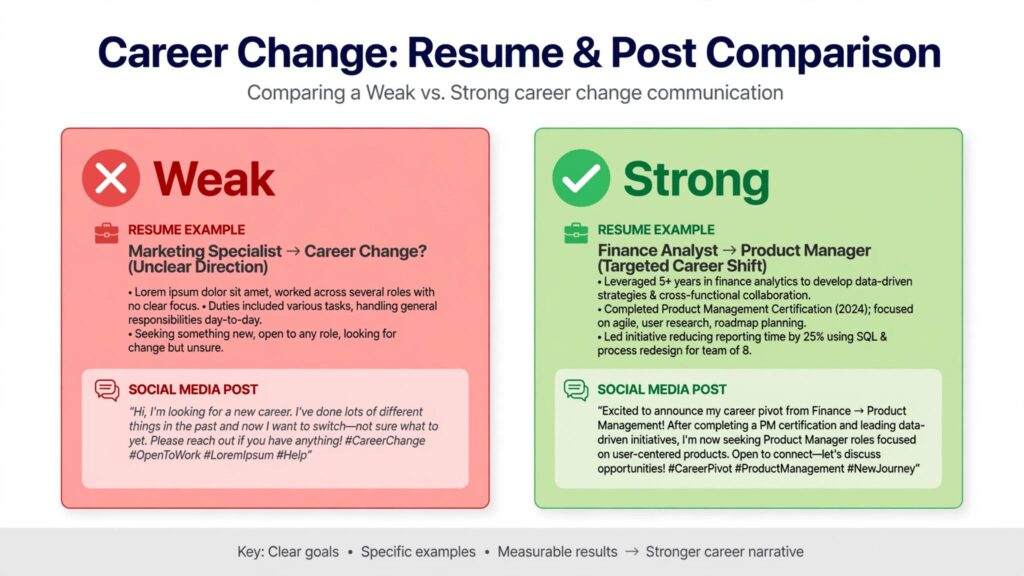
The summary at the top of your resume is where you explain the switch in two or three lines. Compare these:
- Weak: “Looking for any opportunity to learn and grow in a new field.”
- Strong: “Retail supervisor with six years of team leadership and customer service experience, now moving into customer success. Completed a CRM certificate and built a sample support workflow.”
The strong version names the old strength, the new direction, and the proof. If you want a deeper walkthrough, our career change guide covers resume wording, cover letters, and timelines.

Beginner-Friendly Roles to Consider
These roles are popular answers to how to change careers with no experience, because they often accept people from different backgrounds as long as you show the right skills:
- Customer success or support associate
- HR or recruiting coordinator
- Project coordinator
- Content or social media assistant
- Junior data analyst or data entry specialist
- Virtual assistant
- IT help desk support
Many of these can be done remotely, so if flexibility matters to you, read our remote work guide before you apply.
How to Answer “Why Are You Changing Careers?”
Every interviewer will ask this, because they want proof that you thought through how to change careers with no experience instead of drifting. Do not apologise and do not complain about your old job. Use a simple three-part answer: what you learned, why the new field appeals to you, and what you have done to prepare.
For example: “In my teaching job, I loved explaining ideas and helping people improve. I realised that this is exactly what a trainer does in a company, so I completed a course in learning design and built a short sample workshop. I am excited to apply those skills here.”
Practice your answer out loud until it sounds natural. Our interview guides include more common questions and sample responses.
Mistakes to Avoid When Learning How to Change Careers With No Experience
- Applying to everything: A scattered search hides your story.
- Hiding your old experience: Your past is an asset, so use it.
- Waiting until you feel ready: You will never feel fully ready, so start small.
- Skipping proof: Skills with no evidence are easy to ignore.
- Expecting speed: A switch often takes a few months, so plan your budget and your energy.

Frequently Asked Questions
Can I follow a plan for how to change careers with no experience at 30, 40, or later?
Yes. Employers value reliability, judgement, and communication, and those usually grow with age. The key is to show that you are learning the new field actively.
Do I need a degree to change careers?
Not always. Many entry-level roles care more about skills, projects, and certificates than about a new degree. Check the listings for your target role to see what is truly required.
How long does a career change take?
It depends on the gap between your old and new field. Many people spend three to nine months learning, building proof, and applying. Moving into an adjacent role is usually faster.
Should I take a pay cut when I switch?
Sometimes, at least at first. Starting at a junior level can mean a lower salary, but strong performance often brings quick raises. Plan your finances before you leave a stable job.
Conclusion
Knowing how to change careers with no experience comes down to a clear sequence: understand your why, list your transferable skills, choose a realistic target, learn what is missing, build proof, rewrite your resume, and connect with people. You do not need a perfect plan, only a first step.
Pick one action today, whether that is browsing listings or writing your skills list, and finish it before the weekend. Your next career starts with that one small move.

